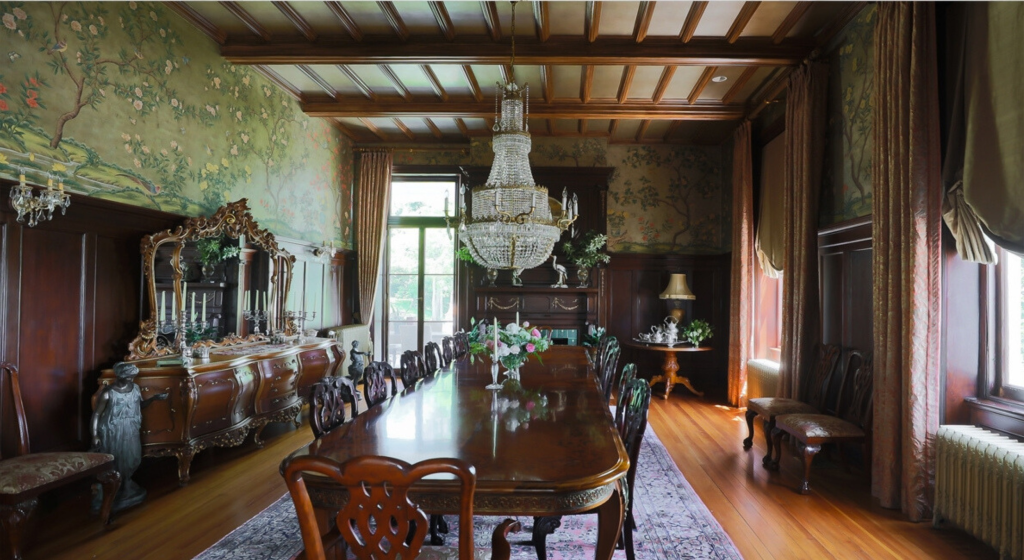
One of the most memorable restoration projects of my career took place in the dining room of the historic Selma Mansion. Before work began, the room was in rough condition. Years of water infiltration had caused extensive damage to the plaster walls and ceiling, while much of the beautiful mahogany woodwork had deteriorated beyond repair. Looking at the room today, it is hard to imagine just how much work was required to bring it back to life.

My involvement with the mansion actually began upstairs, where I was hired to wood grain eighteen oversized doors. The scale of the home was remarkable, with soaring ceilings, massive architectural details, and rooms designed to impress. The doors were finished in an antique mahogany wood grain, carefully crafted to complement the historic character of the home.
Once that phase of the project was completed, we moved downstairs to tackle the dining room restoration.
The first challenge was the plaster. Large sections had been damaged by water and could not be saved. My crew and I carefully removed all deteriorated plaster, resecured the original wood lath, and rebuilt the damaged areas using traditional plastering methods. New scratch coats and finish coats were applied to restore the walls and ceiling while maintaining the character and profile of the original work.
The water damage had also taken a heavy toll on the room’s woodwork. In many areas, the original mahogany trim was too far gone to be restored and had to be replaced by skilled carpenters. If memory serves correctly, a portion of the roof above the room had been missing at one time, allowing water to enter and cause years of damage.

After the plaster restoration was complete, our focus shifted to the ceiling. New wood elements had been installed alongside original materials, creating the challenge of blending old and new together seamlessly. Every piece of woodwork was sanded, primed, sanded again, and carefully prepared for finishing.
To recreate the warmth and elegance appropriate for the room, I applied a multi-layer decorative faux finish to the ceiling beams and trim. The finish was designed to harmonize with the refinished wood floors and surrounding architectural details, creating the appearance of rich, naturally aged wood rather than newly installed material.

The wall paneling required an equally extensive restoration process. My assistants and I spent countless hours removing old finishes and carefully restoring the wood beneath. The paneling was stripped, sanded, and bleached back to its natural color before receiving a wood conditioner and stain. After sealing the surface, multiple rounds of sanding were performed to achieve an exceptionally smooth finish.
For the final protective coating, we applied several coats of oil-based polyurethane. A small amount of burnt umber was added to the finish, giving the wood a subtle warmth and depth. This technique helped create the appearance of beautifully aged mahogany rather than wood that had simply been refinished.
Once our work was complete, a specialty firm from New York installed the custom wall coverings. Decorators followed with draperies, furnishings, lighting, and accessories. Watching the room come together was incredibly rewarding.
Today, the dining room stands as a testament to traditional craftsmanship and historic preservation. What was once a water-damaged space in danger of losing its original character has been transformed into one of the most elegant rooms in the mansion. Projects like this remind me why I love restoration work. There is something deeply satisfying about preserving history and helping ensure that these beautiful spaces can be enjoyed for generations to come.